New Batch Starting Soon Enroll Now!

New Batch Starting on 25 JAN 2025!

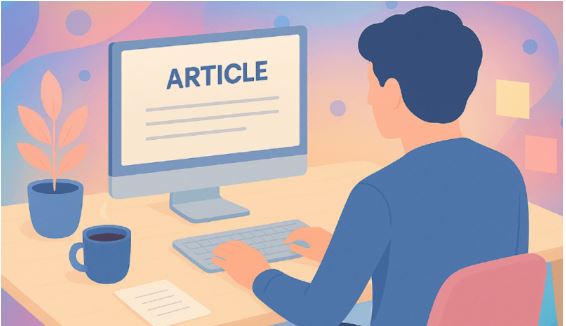
A good article is not created by simply putting words on a page, it is created using its clarity, structure, intent, and experience. The content that performs the best currently is the one that offers value through useful information, readability, clever formatting as well as visual support.
As opposed to a step-by-step tutorial, we have a more realistic dissection of what makes the difference between mediocre and successful articles.
One of the errors made is writing generally about something rather than the reasons why a person is searching for it.
Before you begin, ask:
Articles that are suitable tend to be more straightforward, more useful and more complete.
Imagine that your article is a road not a fence.
Smart structure typically contains:
Readers do not read in a linear manner, they scan first. When your building is tidy, they do last.
It is nearly always preferable that writing is simple.
Rather than attempting to sound as an expert, attempt to sound reciprocity. That means:
When a sentence happens to be heavy, chances are that it is.
Not all the words will be read by the majority of the readers. It is your role to ensure that they still derive value even though they can be skimming.
You can do this by:
Good articles are rewarding to both the deep and the fast readers.
Theoretical suggestions are not memorable. It is memorable because of concrete examples.
Instead of saying:
“Use strong introductions”
Show it:
Don’t begin with a definition, begin with a problem that your reader knows.
Cases facilitate the distance between theory and practice.
Your article can be good--but when your headings are feeble you have no time to enjoy it as a whole.
Strong headings:
Compare:
vs
One asks, the other one becomes disregarded.
People tend to ignore images, which has a significant impact on the user experience and the SEO.
They help:
Of equal importance as the use of images is the source of the images. The reputable platforms can be used and make sure of the proper licensing and quality.
There are three sources that are widely regarded to be trustworthy:
Also, in the case of images, remember to:
Your content should be accompanied by images and not merely space.
There is a difference between writing and editing.
When editing:
A good rule: do not read out a sentence which you would not write yourself.
Do not allow your article to die away. A strong ending should:
The end result can make your content complete even in a short conclusion.
The best articles are not long because they are more understandable, more purposeful, and more simple to read. Once you pay attention to structure, readability and user experience (including graphics) then your content is naturally more effective.
It is not about writing more, it is writing in a manner that people will love to read.
.jpg)

A good article is not created by simply putting words on a page, it is created using its clarity, structure, intent, and experience. The content that performs the best currently is the one that offers value through useful information, readability, clever formatting as well as visual support.
As opposed to a step-by-step tutorial, we have a more realistic dissection of what makes the difference between mediocre and successful articles.
One of the errors made is writing generally about something rather than the reasons why a person is searching for it.
Before you begin, ask:
Articles that are suitable tend to be more straightforward, more useful and more complete.
Imagine that your article is a road not a fence.
Smart structure typically contains:
Readers do not read in a linear manner, they scan first. When your building is tidy, they do last.
It is nearly always preferable that writing is simple.
Rather than attempting to sound as an expert, attempt to sound reciprocity. That means:
When a sentence happens to be heavy, chances are that it is.
Not all the words will be read by the majority of the readers. It is your role to ensure that they still derive value even though they can be skimming.
You can do this by:
Good articles are rewarding to both the deep and the fast readers.
Theoretical suggestions are not memorable. It is memorable because of concrete examples.
Instead of saying:
“Use strong introductions”
Show it:
Don’t begin with a definition, begin with a problem that your reader knows.
Cases facilitate the distance between theory and practice.
Your article can be good--but when your headings are feeble you have no time to enjoy it as a whole.
Strong headings:
Compare:
vs
One asks, the other one becomes disregarded.
People tend to ignore images, which has a significant impact on the user experience and the SEO.
They help:
Of equal importance as the use of images is the source of the images. The reputable platforms can be used and make sure of the proper licensing and quality.
There are three sources that are widely regarded to be trustworthy:
Also, in the case of images, remember to:
Your content should be accompanied by images and not merely space.
There is a difference between writing and editing.
When editing:
A good rule: do not read out a sentence which you would not write yourself.
Do not allow your article to die away. A strong ending should:
The end result can make your content complete even in a short conclusion.
The best articles are not long because they are more understandable, more purposeful, and more simple to read. Once you pay attention to structure, readability and user experience (including graphics) then your content is naturally more effective.
It is not about writing more, it is writing in a manner that people will love to read.