New Batch Starting Soon Enroll Now!

New Batch Starting on 25 JAN 2025!

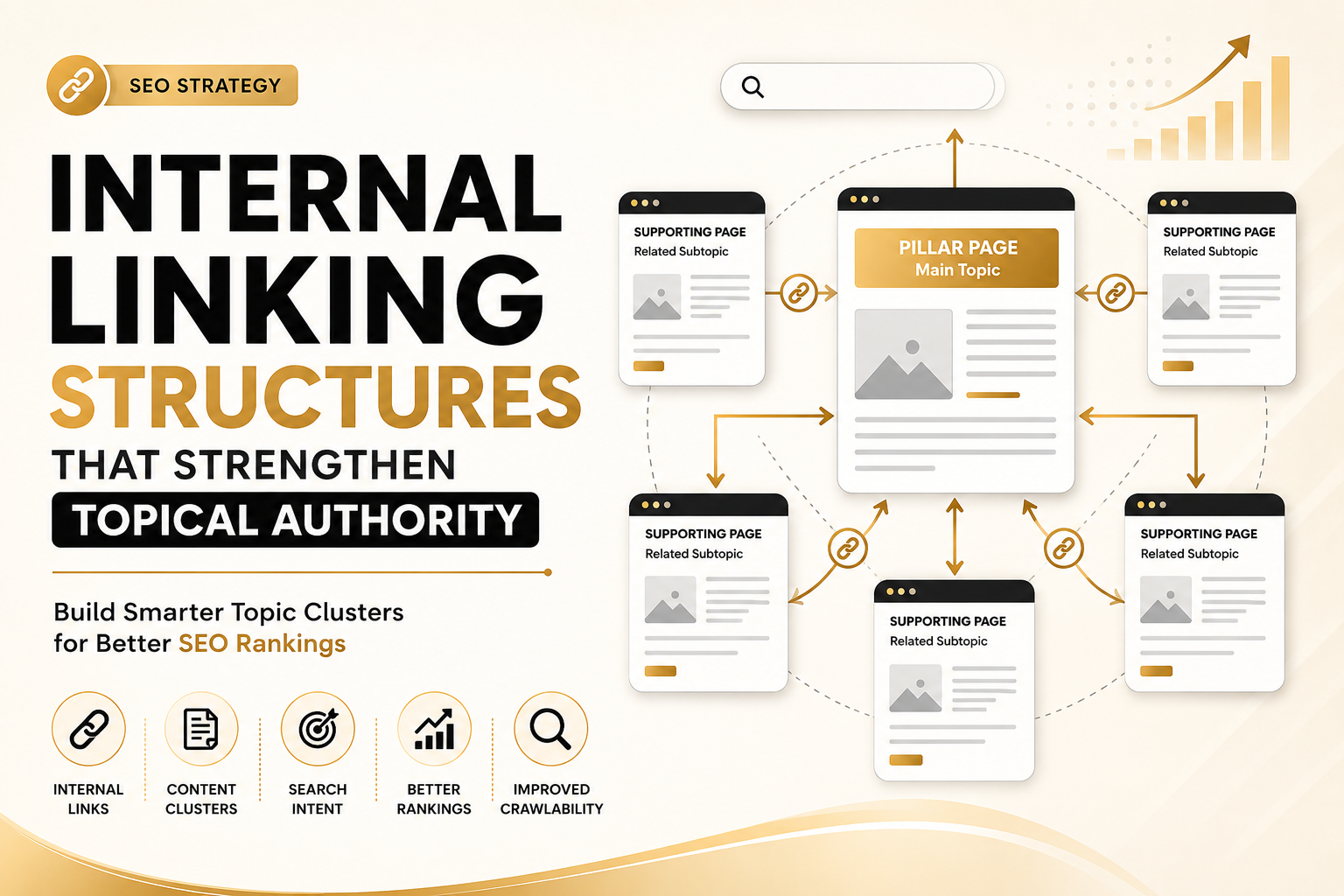
Internal linking often gets treated as website housekeeping: fix an orphan page, add a few related articles, and move on. Treating the work this way misses its strategic value. Links inside your own site shape how visitors move from a question to a solution, help Google discover URLs, and show how products, services, and supporting expertise fit together.
“Topical authority” is useful industry shorthand, not a score that Google publishes. A stronger internal structure will not rescue weak content or replace external reputation. It can, however, make a valuable body of work easier to find, interpret, and use. For SEO specialists, that means clearer crawl paths and page relationships. For marketers, it means better journeys between educational and commercial content. For business leaders, it means extracting more value from pages the company has already paid to create.
The task is not to maximise link counts. It is to build a deliberate network in which important pages receive appropriate support, related content is genuinely connected, and every route makes sense to a person as well as a crawler.
Start with the business model rather than the blog archive. List the products, services, locations, or solution categories that matter commercially, then map the questions a buyer asks before choosing one of them. This prevents the common mistake of designing clusters around keyword volume while leaving high-value pages disconnected from the content that creates demand for them.
A B2B accounting platform, for example, might treat its core software page as a commercial destination. Guides about payroll compliance, month-end close, cash-flow forecasting, and tax reporting support that destination, but they do not all serve the same reader or stage of the journey. Payroll articles may deserve their own subcluster, while a comparison page should link more directly to product capabilities and proof. The map must capture those distinctions before anyone starts inserting links.
Large sites rarely have a clean inventory. Migrations, campaign landing pages, acquired domains, and years of decentralised publishing create duplicate topics and orphan URLs. A capable SEO agency can help a team crawl that estate, connect page-level data with commercial priorities, and identify structural risks before templates are changed. An external review is not mandatory, but independent mapping can be useful when no internal owner has a reliable view of the whole site.
Build the map with four inputs: each page’s main purpose, its intended audience, the search intent it serves, and the next useful action. Revenue and lead data should inform priority, but informational pages should not be judged only by direct conversions. A guide may assist a later sale, attract links, answer a support question, or qualify a prospect. Its links should reflect the role it actually plays.
The output can be a spreadsheet or visual map, but every included relationship needs a reason. “These pages mention the same phrase” is weak. “This guide answers the question that commonly arises before a buyer evaluates this service” is much stronger. Good internal linking begins with that level of editorial judgement.
A hub is useful when it helps someone navigate a broad subject, not merely because a content template calls for one. The hub should establish the scope of the topic, route visitors to distinct subtopics, and provide a clear path toward a relevant commercial action. Supporting pages should link back where the hub offers genuine context, but a rigid requirement that every spoke link to every other spoke creates clutter rather than clarity.
Consider a commercial roofing company. Its main roofing-services page may link to hubs for installation, maintenance, and emergency repair. The maintenance hub can then connect roof-inspection guidance, material-specific upkeep, warning signs, and regional service pages. A visitor researching a leak should not have to pass through an abstract “roofing resources” page before reaching emergency help. Search intent should determine the route.
Google’s current SEO Starter Guide explains that pages are commonly discovered through links from URLs Google has already crawled. It also recommends organising a site logically so users and search engines can understand how pages relate. A sitemap helps discovery, but it does not replace useful navigation and crawlable internal paths.
Hierarchy also communicates operational priorities. Pages placed close to primary navigation and linked from strong hubs are easier for visitors and crawlers to reach than URLs buried six clicks deep. Depth alone is not a ranking formula, though. A legal policy page may be close to the homepage without being a search priority, while a specialised product guide may sit deeper because that arrangement makes sense to its audience.
Review the hierarchy from three perspectives. An SEO specialist should check crawlability and duplication. A marketer should test whether the journey matches intent and campaign messaging. A business owner should confirm that strategic services and differentiators are not hidden behind editorial categories nobody outside the content team understands. A structure works only when all three views can be reconciled.
Navigation establishes the framework; contextual links add precision. A link inside a useful sentence can explain why another page matters at that moment. It can take a reader from a general concept to a worked example, from a problem to a service, or from a product feature to evidence that supports it.
Google’s guidance on crawlable links and anchor text recommends standard anchor elements with resolvable URLs. It also advises using anchor text that is descriptive, concise, relevant to the destination, and supported by surrounding context. “Read more” tells the reader very little. “Compare payroll reporting requirements by state” sets a clear expectation.
Context matters more than exact-match repetition. Reusing the same commercial phrase in dozens of articles can make copy awkward and may obscure the reason for each link. Natural variations, product names, question-based anchors, and descriptive phrases are usually more useful. The destination should fulfil the promise made by the words around the link.
A controlled SearchPilot experiment provides a helpful scale example. The site had roughly 8,000 US regional pages. SearchPilot added links from each tested regional page to six nearby variant-group regions, giving destination pages about 12 additional incoming links on average. The linked destination pages recorded a 7% organic-traffic uplift against the control group. The result does not mean every site should cross-link locations. It shows that a systematic, relevant connection can improve performance where a large page network previously lacked it.
Donor pages need monitoring too. Internal links redistribute attention and internal signals; they do not create authority from nothing. SearchPilot notes that a link test can help destination pages while producing a different effect on source pages. Measure both groups whenever templates or high-traffic pages are involved.
A structure begins ageing as soon as the site changes. New articles launch without links from older pages. Products disappear while comparison guides continue pointing to them. Navigation templates change, leaving formerly supported URLs with fewer incoming paths. Quarterly audits are useful for active sites, while large ecommerce, publishing, and marketplace platforms may need continuous monitoring.
Start by combining crawl data with analytics and Search Console exports. A crawler reveals internal link counts, depth, broken destinations, redirects, non-crawlable implementations, and orphan candidates. Analytics shows which pages participate in valuable journeys. Search Console reveals impressions and clicks that may be at risk. No single dataset can explain the whole structure.
Google states that every page a site owner cares about should receive a link from at least one other page. The statement provides a baseline, not a quota. One weak link from an archive may technically prevent orphan status while doing little for discovery or users. Audit whether strategically important URLs receive links from relevant, frequently used pages and whether those links are visible in rendered HTML.
Zyppy’s study of 23 million internal links across 1,800 sites illustrates why raw counts require caution. URLs with 0 to 4 incoming internal links averaged 2 Google Search clicks, while pages with 40 to 44 averaged four times as many. The study is correlational, not proof that adding links will multiply traffic. Successful pages may naturally attract more links, and sitewide navigation can inflate counts. The practical lesson is to find severe under-linking, not chase 44 as a universal target.
Prioritise audit findings by business effect. A broken link in an old news post is usually less urgent than an orphaned service page tied to a major sales line. Fix links leading to errors, replace avoidable redirect chains with final URLs, integrate valuable orphan pages, and remove links that no longer help a user. Record who owns each template so the same problems do not return after the next release.
Google does not provide a topical-authority dashboard, so evaluation needs a defined test. Select a set of destination pages, document the links they receive, record a baseline period, and note other releases that could affect performance. Compare impressions, clicks, organic sessions, conversions, and assisted journeys. Page discovery and crawl behaviour may also matter when the affected URLs are new or deep.
Controlled experiments offer stronger evidence than simple before-and-after charts, but even experiments are site-specific. Two SearchPilot tests show both the opportunity and the limits of generalisation.
The homepage-footer experiment is particularly instructive. A positive estimated uplift did not make a giant footer a universal recommendation. The pattern was normal for that client’s industry, and device-level confidence differed. Business context, usability, and test quality still matter.
Track leading and commercial indicators together. More clicks with no improvement in qualified actions may indicate that the structure is attracting the wrong audience or sending visitors to an unsuitable next step. Better assisted-conversion paths, stronger product discovery, or reduced support friction may be valuable even when direct organic growth is modest.
Internal links strengthen a site when they make its expertise easier to navigate and its important pages easier to discover. The durable approach is not to manufacture dense link webs. Map real relationships, design hubs around intent, add contextual routes where they help, audit coverage, and measure the result against business outcomes. This discipline turns internal architecture into a working asset rather than another SEO checklist.
.jpg)

Internal linking often gets treated as website housekeeping: fix an orphan page, add a few related articles, and move on. Treating the work this way misses its strategic value. Links inside your own site shape how visitors move from a question to a solution, help Google discover URLs, and show how products, services, and supporting expertise fit together.
“Topical authority” is useful industry shorthand, not a score that Google publishes. A stronger internal structure will not rescue weak content or replace external reputation. It can, however, make a valuable body of work easier to find, interpret, and use. For SEO specialists, that means clearer crawl paths and page relationships. For marketers, it means better journeys between educational and commercial content. For business leaders, it means extracting more value from pages the company has already paid to create.
The task is not to maximise link counts. It is to build a deliberate network in which important pages receive appropriate support, related content is genuinely connected, and every route makes sense to a person as well as a crawler.
Start with the business model rather than the blog archive. List the products, services, locations, or solution categories that matter commercially, then map the questions a buyer asks before choosing one of them. This prevents the common mistake of designing clusters around keyword volume while leaving high-value pages disconnected from the content that creates demand for them.
A B2B accounting platform, for example, might treat its core software page as a commercial destination. Guides about payroll compliance, month-end close, cash-flow forecasting, and tax reporting support that destination, but they do not all serve the same reader or stage of the journey. Payroll articles may deserve their own subcluster, while a comparison page should link more directly to product capabilities and proof. The map must capture those distinctions before anyone starts inserting links.
Large sites rarely have a clean inventory. Migrations, campaign landing pages, acquired domains, and years of decentralised publishing create duplicate topics and orphan URLs. A capable SEO agency can help a team crawl that estate, connect page-level data with commercial priorities, and identify structural risks before templates are changed. An external review is not mandatory, but independent mapping can be useful when no internal owner has a reliable view of the whole site.
Build the map with four inputs: each page’s main purpose, its intended audience, the search intent it serves, and the next useful action. Revenue and lead data should inform priority, but informational pages should not be judged only by direct conversions. A guide may assist a later sale, attract links, answer a support question, or qualify a prospect. Its links should reflect the role it actually plays.
The output can be a spreadsheet or visual map, but every included relationship needs a reason. “These pages mention the same phrase” is weak. “This guide answers the question that commonly arises before a buyer evaluates this service” is much stronger. Good internal linking begins with that level of editorial judgement.
A hub is useful when it helps someone navigate a broad subject, not merely because a content template calls for one. The hub should establish the scope of the topic, route visitors to distinct subtopics, and provide a clear path toward a relevant commercial action. Supporting pages should link back where the hub offers genuine context, but a rigid requirement that every spoke link to every other spoke creates clutter rather than clarity.
Consider a commercial roofing company. Its main roofing-services page may link to hubs for installation, maintenance, and emergency repair. The maintenance hub can then connect roof-inspection guidance, material-specific upkeep, warning signs, and regional service pages. A visitor researching a leak should not have to pass through an abstract “roofing resources” page before reaching emergency help. Search intent should determine the route.
Google’s current SEO Starter Guide explains that pages are commonly discovered through links from URLs Google has already crawled. It also recommends organising a site logically so users and search engines can understand how pages relate. A sitemap helps discovery, but it does not replace useful navigation and crawlable internal paths.
Hierarchy also communicates operational priorities. Pages placed close to primary navigation and linked from strong hubs are easier for visitors and crawlers to reach than URLs buried six clicks deep. Depth alone is not a ranking formula, though. A legal policy page may be close to the homepage without being a search priority, while a specialised product guide may sit deeper because that arrangement makes sense to its audience.
Review the hierarchy from three perspectives. An SEO specialist should check crawlability and duplication. A marketer should test whether the journey matches intent and campaign messaging. A business owner should confirm that strategic services and differentiators are not hidden behind editorial categories nobody outside the content team understands. A structure works only when all three views can be reconciled.
Navigation establishes the framework; contextual links add precision. A link inside a useful sentence can explain why another page matters at that moment. It can take a reader from a general concept to a worked example, from a problem to a service, or from a product feature to evidence that supports it.
Google’s guidance on crawlable links and anchor text recommends standard anchor elements with resolvable URLs. It also advises using anchor text that is descriptive, concise, relevant to the destination, and supported by surrounding context. “Read more” tells the reader very little. “Compare payroll reporting requirements by state” sets a clear expectation.
Context matters more than exact-match repetition. Reusing the same commercial phrase in dozens of articles can make copy awkward and may obscure the reason for each link. Natural variations, product names, question-based anchors, and descriptive phrases are usually more useful. The destination should fulfil the promise made by the words around the link.
A controlled SearchPilot experiment provides a helpful scale example. The site had roughly 8,000 US regional pages. SearchPilot added links from each tested regional page to six nearby variant-group regions, giving destination pages about 12 additional incoming links on average. The linked destination pages recorded a 7% organic-traffic uplift against the control group. The result does not mean every site should cross-link locations. It shows that a systematic, relevant connection can improve performance where a large page network previously lacked it.
Donor pages need monitoring too. Internal links redistribute attention and internal signals; they do not create authority from nothing. SearchPilot notes that a link test can help destination pages while producing a different effect on source pages. Measure both groups whenever templates or high-traffic pages are involved.
A structure begins ageing as soon as the site changes. New articles launch without links from older pages. Products disappear while comparison guides continue pointing to them. Navigation templates change, leaving formerly supported URLs with fewer incoming paths. Quarterly audits are useful for active sites, while large ecommerce, publishing, and marketplace platforms may need continuous monitoring.
Start by combining crawl data with analytics and Search Console exports. A crawler reveals internal link counts, depth, broken destinations, redirects, non-crawlable implementations, and orphan candidates. Analytics shows which pages participate in valuable journeys. Search Console reveals impressions and clicks that may be at risk. No single dataset can explain the whole structure.
Google states that every page a site owner cares about should receive a link from at least one other page. The statement provides a baseline, not a quota. One weak link from an archive may technically prevent orphan status while doing little for discovery or users. Audit whether strategically important URLs receive links from relevant, frequently used pages and whether those links are visible in rendered HTML.
Zyppy’s study of 23 million internal links across 1,800 sites illustrates why raw counts require caution. URLs with 0 to 4 incoming internal links averaged 2 Google Search clicks, while pages with 40 to 44 averaged four times as many. The study is correlational, not proof that adding links will multiply traffic. Successful pages may naturally attract more links, and sitewide navigation can inflate counts. The practical lesson is to find severe under-linking, not chase 44 as a universal target.
Prioritise audit findings by business effect. A broken link in an old news post is usually less urgent than an orphaned service page tied to a major sales line. Fix links leading to errors, replace avoidable redirect chains with final URLs, integrate valuable orphan pages, and remove links that no longer help a user. Record who owns each template so the same problems do not return after the next release.
Google does not provide a topical-authority dashboard, so evaluation needs a defined test. Select a set of destination pages, document the links they receive, record a baseline period, and note other releases that could affect performance. Compare impressions, clicks, organic sessions, conversions, and assisted journeys. Page discovery and crawl behaviour may also matter when the affected URLs are new or deep.
Controlled experiments offer stronger evidence than simple before-and-after charts, but even experiments are site-specific. Two SearchPilot tests show both the opportunity and the limits of generalisation.
The homepage-footer experiment is particularly instructive. A positive estimated uplift did not make a giant footer a universal recommendation. The pattern was normal for that client’s industry, and device-level confidence differed. Business context, usability, and test quality still matter.
Track leading and commercial indicators together. More clicks with no improvement in qualified actions may indicate that the structure is attracting the wrong audience or sending visitors to an unsuitable next step. Better assisted-conversion paths, stronger product discovery, or reduced support friction may be valuable even when direct organic growth is modest.
Internal links strengthen a site when they make its expertise easier to navigate and its important pages easier to discover. The durable approach is not to manufacture dense link webs. Map real relationships, design hubs around intent, add contextual routes where they help, audit coverage, and measure the result against business outcomes. This discipline turns internal architecture into a working asset rather than another SEO checklist.