New Batch Starting Soon Enroll Now!

New Batch Starting on 25 JAN 2025!

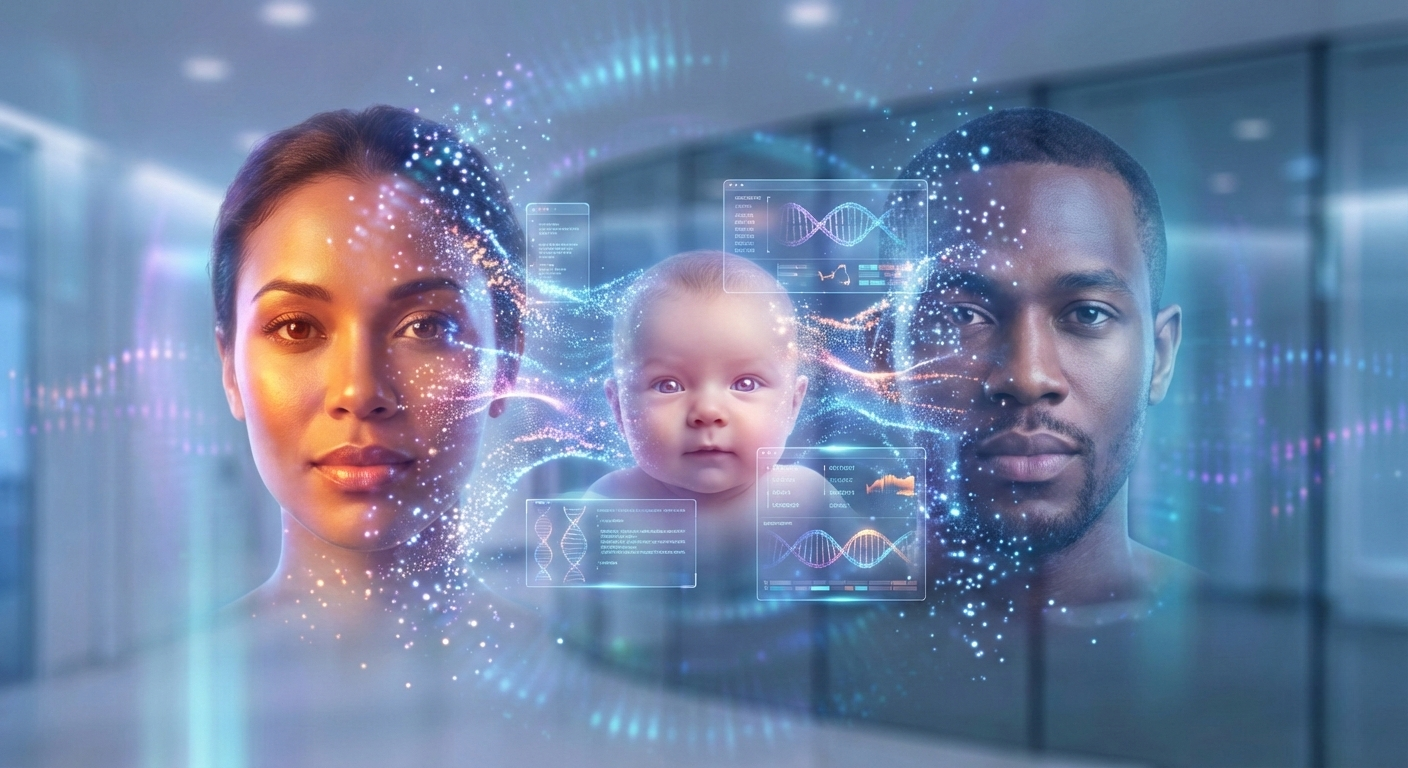
Remember the scene in old sci-fi movies where a computer would scan two astronauts and instantly display a hologram of their potential offspring? It seemed like pure Hollywood magic—a plot device used to raise the stakes or add a touch of romance to a space opera.
We grew up thinking that kind of technology was centuries away. We thought we’d have flying cars before we had digital genetics.
Well, the flying cars are still stuck in traffic, but the digital genetics? They are here. And they are sitting right in your web browser.
The fascination with heredity is hardwired into our biology. We are programmed to look for ourselves in others. It’s why the first thing anyone says at a baby shower is, "He has his father's nose!" or "She definitely got her mother's eyes." We are obsessed with the remixing of traits.
Today, we don't have to wait nine months to see the result of that remix. With the AI Baby Generator, you can bypass biology and jump straight to the result. It’s not just a fun party trick; it’s a testament to how far artificial intelligence has come in understanding the human face.
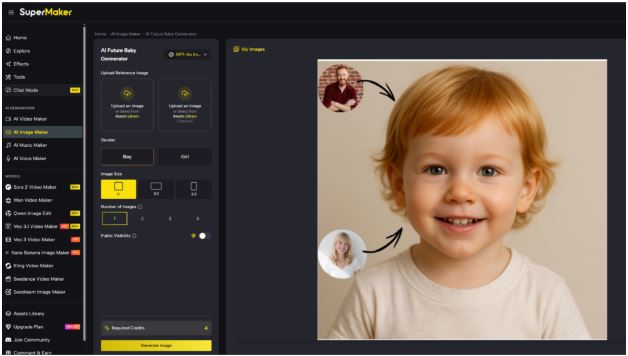
I wanted to test the limits of this technology, but not in the usual "lovey-dovey" way. I wanted to see if it could handle contrast.
I work in a creative agency with a diverse team. During a lunch break, I grabbed my colleague, Dave (who has a thick, red beard and pale skin), and Sarah (who has dark skin and sleek, black hair). We uploaded their photos to Supermaker as a joke, expecting the AI to crash or produce a blurry mess.
We were wrong.
The result was a stunningly cute baby girl. The AI had intelligently blended their skin tones to a rich, warm caramel. It gave the baby Sarah’s dark eyes but framed them with Dave’s slightly arched eyebrows. It even hinted at a reddish tint in the curly hair.
The entire break room erupted. "That kid is cuter than both of you!" someone shouted. It turned a boring Tuesday lunch into a hilarious, bonding experience. It showed me that this tool isn't just for couples planning a future; it’s a sandbox for curiosity.
To appreciate the baby generator ai free tool, you have to understand that it isn't "guessing." It is calculating.
When you use a standard face-swap filter, the computer is just cutting and pasting pixels. It’s like a digital collage. AI generation is different. It uses Deep Learning.
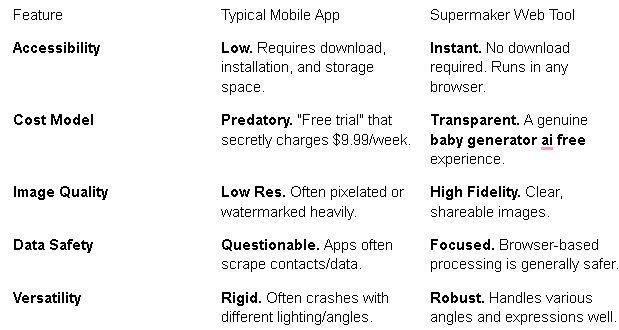
There are dozens of apps on the App Store that promise to predict your baby's face. Most of them are riddled with ads, require a credit card, or simply don't work.
Here is a critical look at why Supermaker’s web-based solution is superior to the cluttered app ecosystem.

You don't need to be in a relationship to enjoy this. The internet has turned AI Video Generatotr Agent into a new form of content creation
This is a trend taking over TikTok. What would the child of Taylor Swift and Harry Styles look like? Or Brad Pitt and Jennifer Lawrence? Users are generating these "Hollywood Royal Babies" and the results are often viral-worthy. It’s a fun way to engage with celebrity culture.
Are you a writer? A D&D player? A Sims enthusiast? If you are creating a character who is the child of two existing characters, stop describing them and start showing them. Use the generator to create visual references for your stories or campaigns.
Here is a sentimental idea: Upload a photo of your own parents (from when they were young) to see if the AI generates a baby that looks like you. It’s a fascinating test of accuracy and a weirdly touching way to connect with your family history.
The AI is smart, but it’s not a miracle worker. If you feed it garbage data, you will get a garbage result. Follow these three golden rules for the best baby photos:
Think of how you take a passport photo. Neutral expression, facing forward, even lighting. This is the gold standard for AI. While you don't need to look serious, you should face the camera directly.
If your hair is covering your forehead or eyes, the AI has to "guess" what’s underneath. Sometimes it guesses wrong. Pull your hair back or choose a photo where your face is framed clearly.
Try to use photos of the "parents" that have similar lighting. If Dad is in a dark room and Mom is in bright sunlight, the AI might struggle to balance the skin tone of the baby, resulting in unnatural shadows.
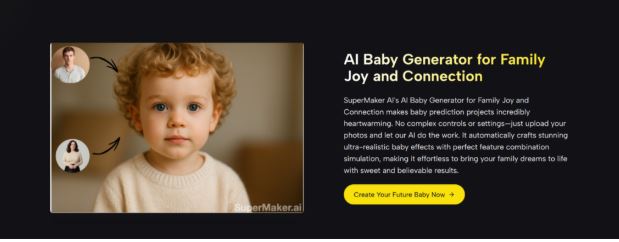
We live in a world that is often heavy and serious. We worry about the economy, the climate, and the news. Sometimes, we just need a minute of pure, unadulterated wonder.
The baby generator ai free tool offers exactly that. It is a brief escape into a "what if" scenario that is harmless, free, and surprisingly poignant. It reminds us of the continuity of life, the blending of traits, and the simple beauty of a human face.
Whether you are using it to prank your friends, visualize a future with your partner, or just mess around with celebrity photos, the technology is there to serve your imagination.
So, why not take a peek? The future is knocking, and it looks adorable.
.jpg)

Remember the scene in old sci-fi movies where a computer would scan two astronauts and instantly display a hologram of their potential offspring? It seemed like pure Hollywood magic—a plot device used to raise the stakes or add a touch of romance to a space opera.
We grew up thinking that kind of technology was centuries away. We thought we’d have flying cars before we had digital genetics.
Well, the flying cars are still stuck in traffic, but the digital genetics? They are here. And they are sitting right in your web browser.
The fascination with heredity is hardwired into our biology. We are programmed to look for ourselves in others. It’s why the first thing anyone says at a baby shower is, "He has his father's nose!" or "She definitely got her mother's eyes." We are obsessed with the remixing of traits.
Today, we don't have to wait nine months to see the result of that remix. With the AI Baby Generator, you can bypass biology and jump straight to the result. It’s not just a fun party trick; it’s a testament to how far artificial intelligence has come in understanding the human face.
I wanted to test the limits of this technology, but not in the usual "lovey-dovey" way. I wanted to see if it could handle contrast.
I work in a creative agency with a diverse team. During a lunch break, I grabbed my colleague, Dave (who has a thick, red beard and pale skin), and Sarah (who has dark skin and sleek, black hair). We uploaded their photos to Supermaker as a joke, expecting the AI to crash or produce a blurry mess.
We were wrong.
The result was a stunningly cute baby girl. The AI had intelligently blended their skin tones to a rich, warm caramel. It gave the baby Sarah’s dark eyes but framed them with Dave’s slightly arched eyebrows. It even hinted at a reddish tint in the curly hair.
The entire break room erupted. "That kid is cuter than both of you!" someone shouted. It turned a boring Tuesday lunch into a hilarious, bonding experience. It showed me that this tool isn't just for couples planning a future; it’s a sandbox for curiosity.
To appreciate the baby generator ai free tool, you have to understand that it isn't "guessing." It is calculating.
When you use a standard face-swap filter, the computer is just cutting and pasting pixels. It’s like a digital collage. AI generation is different. It uses Deep Learning.
There are dozens of apps on the App Store that promise to predict your baby's face. Most of them are riddled with ads, require a credit card, or simply don't work.
Here is a critical look at why Supermaker’s web-based solution is superior to the cluttered app ecosystem.
You don't need to be in a relationship to enjoy this. The internet has turned AI Video Generatotr Agent into a new form of content creation
This is a trend taking over TikTok. What would the child of Taylor Swift and Harry Styles look like? Or Brad Pitt and Jennifer Lawrence? Users are generating these "Hollywood Royal Babies" and the results are often viral-worthy. It’s a fun way to engage with celebrity culture.
Are you a writer? A D&D player? A Sims enthusiast? If you are creating a character who is the child of two existing characters, stop describing them and start showing them. Use the generator to create visual references for your stories or campaigns.
Here is a sentimental idea: Upload a photo of your own parents (from when they were young) to see if the AI generates a baby that looks like you. It’s a fascinating test of accuracy and a weirdly touching way to connect with your family history.
The AI is smart, but it’s not a miracle worker. If you feed it garbage data, you will get a garbage result. Follow these three golden rules for the best baby photos:
Think of how you take a passport photo. Neutral expression, facing forward, even lighting. This is the gold standard for AI. While you don't need to look serious, you should face the camera directly.
If your hair is covering your forehead or eyes, the AI has to "guess" what’s underneath. Sometimes it guesses wrong. Pull your hair back or choose a photo where your face is framed clearly.
Try to use photos of the "parents" that have similar lighting. If Dad is in a dark room and Mom is in bright sunlight, the AI might struggle to balance the skin tone of the baby, resulting in unnatural shadows.
We live in a world that is often heavy and serious. We worry about the economy, the climate, and the news. Sometimes, we just need a minute of pure, unadulterated wonder.
The baby generator ai free tool offers exactly that. It is a brief escape into a "what if" scenario that is harmless, free, and surprisingly poignant. It reminds us of the continuity of life, the blending of traits, and the simple beauty of a human face.
Whether you are using it to prank your friends, visualize a future with your partner, or just mess around with celebrity photos, the technology is there to serve your imagination.
So, why not take a peek? The future is knocking, and it looks adorable.