New Batch Starting Soon Enroll Now!

New Batch Starting on 25 JAN 2025!

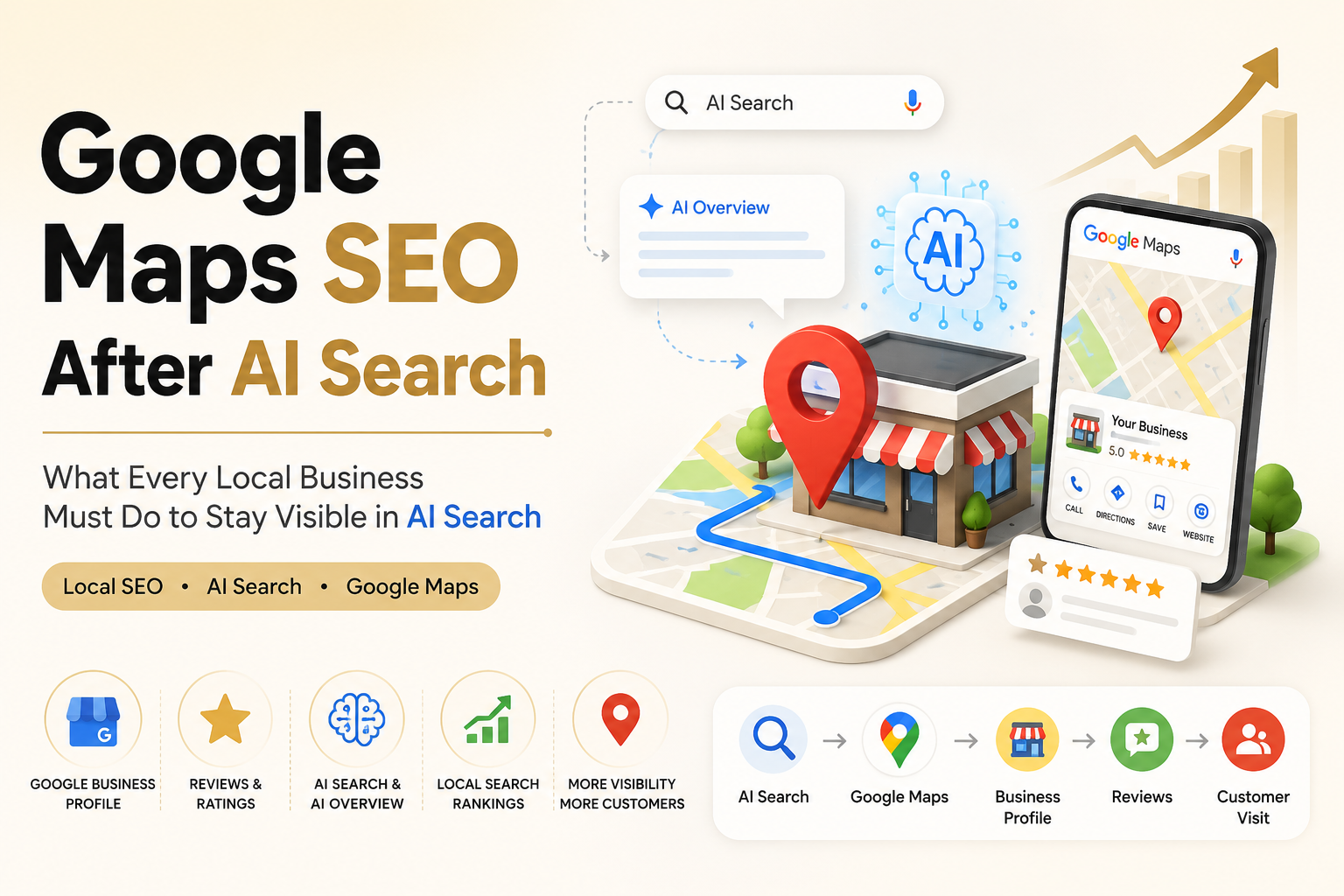
Google changed how people find businesses. AI-powered search now shapes the path users take before they ever open Google Maps. This shift altered user behavior, ranking signals, and what businesses must do to stay visible.
Before AI search, users typed keywords into Google, scanned results, and clicked through to Google Maps or a business website. The process was linear. Users controlled each step.
AI search changed that process. Google's AI Overview now summarizes answers directly on the search results page. Users receive business recommendations, hours, ratings, and location details without clicking anywhere. By the time a user opens Google Maps, they often already have a business in mind.
This behavioral shift has measurable consequences for Google Maps SEO.
Fewer exploratory searches happen inside Maps. Users used to open Google Maps and type "best Italian restaurant near me" to explore options. Now, AI search delivers that list before the user ever opens Maps. Google Maps becomes a confirmation tool, not a discovery tool.
Users arrive with higher intent. When someone opens Google Maps after an AI search interaction, they are closer to making a decision. They want directions, hours, or a phone number. They are not browsing. This means businesses need accurate, complete, and updated information more than ever.
Visual content matters more. AI search often pulls photos, ratings, and brief descriptions into its responses. Users who see a business through AI search form a visual impression before visiting the Maps listing. Businesses with strong photo libraries and clear descriptions perform better in this environment.
Review quality influences first impressions earlier. AI search surfaces ratings and review snippets. A business with a 3.8-star rating and generic reviews may lose a user before that user even opens Maps. The filter now starts at the AI search layer.
What this means practically: Google Maps SEO now requires optimization at two layers — the AI search layer and the Maps listing layer. Businesses that only think about their Google Business Profile miss the first filter entirely.
The traditional search funnel had multiple steps. A user searched, reviewed results, visited a website, compared options, and then made a selection. That funnel gave businesses multiple chances to attract attention and provide information.
AI search compressed that funnel significantly.
The funnel now has fewer steps. A user asks Google, "Where should I get a haircut near downtown?" and AI Overview returns three recommendations with ratings, price ranges, and a brief description of each. The user picks one. The funnel went from five or six steps to two.
This compression creates both problems and opportunities for businesses.
Problem: Less time to make an impression. Businesses no longer get the benefit of a website visit to convince a user. The AI summary is often the only information a user sees. If that summary does not look appealing, the user moves to the next option.
Problem: Businesses with incomplete profiles lose faster. If a business has missing hours, no photos, or few reviews, AI search may skip it entirely when assembling recommendations. Incomplete profiles carry a higher penalty than before.
Opportunity: Businesses with complete, accurate profiles gain more visibility. AI search pulls data from Google Business Profile. Local business profile optimization - the process of completing every field, selecting precise categories, adding photos, and maintaining accurate hours - directly increases the chance of appearing in AI-generated summaries. Businesses that treat this as an ongoing task rather than a one-time setup consistently outperform those that do not.
Opportunity: Specific, niche businesses perform better. AI search responds well to precise queries. A business that clearly identifies itself as a "gluten-free bakery" or "electric vehicle repair shop" in its profile categories and descriptions will appear in highly specific AI search results. Broad, generic descriptions perform worse.
Review recency became a stronger signal. AI search appears to favor businesses with recent, high-quality reviews when building its recommendations. A business with 200 reviews from three years ago may rank below a business with 40 reviews from the past six months. Encouraging recent reviews is now a direct ranking strategy.
Response time to reviews matters more. AI search and Google's ranking algorithm both reward engagement. Businesses that respond to reviews, answer questions in the Q&A section, and post updates signal activity. Active profiles receive better placement in AI-generated results.
Keywords in reviews carry weight. When customers mention specific services in reviews - "amazing gluten-free croissants" or "fast oil change" - those keywords feed into how AI search categorizes and surfaces that business. Businesses can encourage this organically by reminding customers to mention specific services in their feedback.
The compressed funnel rewards preparation. Businesses that treat their Google Business Profile as a living document - updating it regularly, adding photos, responding to reviews, and keeping information current - benefit from AI search. Businesses that set up a profile once and forget it lose ground quickly.
The way users make decisions inside Google Maps shifted after AI search became the entry point for most commercial queries.
Users validate rather than discover. Before AI search, users opened Maps to find options. Now they open Maps to confirm a choice they already leaning toward. This changes what they look at first. They check hours, look at photos, and scan recent reviews. They are not comparing five businesses side by side. They are checking one or two.
The first photo in a listing carries more weight. Users arriving from AI search are already primed with a mental image of a business. The first photo in a Google Maps listing either confirms or disrupts that image. Businesses should prioritize their cover photo carefully. A high-quality, accurate, and representative image increases conversion. A low-quality or outdated image creates doubt.
Negative reviews receive more scrutiny. Users in validation mode look for reasons to disqualify a business, not reasons to choose it. A recent one-star review gets more attention than ten four-star reviews. Businesses need a strategy for handling negative reviews promptly and professionally. An unanswered negative review is a red flag in the validation phase.
Business hours accuracy became critical. Users arriving in validation mode often have a specific visit in mind. If hours are wrong, they leave and do not return. Google has increased the weight it places on hour accuracy in its ranking algorithm. Businesses must update hours for holidays, seasonal changes, and special closures immediately.
The Q&A section now serves as a pre-visit checklist. Users ask questions in the Maps Q&A section and check existing answers before visiting. Businesses that populate this section with accurate, helpful answers reduce friction and increase conversion. Common questions include parking availability, accessibility features, payment methods, and appointment requirements.
Attributes filter decisions. Google Maps allows businesses to add attributes - wheelchair accessible, outdoor seating, women-owned, LGBTQ+ friendly. Users filter by these attributes when making decisions. Businesses that do not add relevant attributes become invisible to filtered searches. Completing the attributes section is a simple, high-impact action.
Photos from the business owner outperform user-uploaded photos. User-uploaded photos are often low quality, poorly framed, or outdated. Businesses that regularly upload professional photos maintain better control over their visual presentation. Google Maps displays owner-uploaded photos prominently when they exist.
Post frequency signals activity. Google Business Profile allows businesses to publish posts - updates, offers, events, and new products. Regular posts signal that a business is active. AI search and the Maps algorithm both appear to favor active profiles. Posting once or twice per month is sufficient to maintain this signal.
The key shift in user decision-making is the move from exploration to confirmation. Businesses that optimize for the confirmation phase - accurate information, strong visuals, recent positive reviews, complete attributes - convert more users who arrive from AI search. Businesses that rely on Maps to do the discovery work for them will see fewer conversions.
AI search did not eliminate Google Maps SEO. It added a new layer before it. Businesses that understand both layers and optimize for each one will maintain and grow their local visibility. Businesses that ignore the AI search layer will see declining traffic even with a well-maintained Maps listing.
The practical checklist is straightforward: complete your profile fully, update it regularly, collect recent reviews, respond to every review, upload quality photos consistently, answer Q&A questions, add all relevant attributes, and publish posts monthly. These actions address both layers - AI search and Maps - and position a business to perform well in the current environment.
.jpg)

Google changed how people find businesses. AI-powered search now shapes the path users take before they ever open Google Maps. This shift altered user behavior, ranking signals, and what businesses must do to stay visible.
Before AI search, users typed keywords into Google, scanned results, and clicked through to Google Maps or a business website. The process was linear. Users controlled each step.
AI search changed that process. Google's AI Overview now summarizes answers directly on the search results page. Users receive business recommendations, hours, ratings, and location details without clicking anywhere. By the time a user opens Google Maps, they often already have a business in mind.
This behavioral shift has measurable consequences for Google Maps SEO.
Fewer exploratory searches happen inside Maps. Users used to open Google Maps and type "best Italian restaurant near me" to explore options. Now, AI search delivers that list before the user ever opens Maps. Google Maps becomes a confirmation tool, not a discovery tool.
Users arrive with higher intent. When someone opens Google Maps after an AI search interaction, they are closer to making a decision. They want directions, hours, or a phone number. They are not browsing. This means businesses need accurate, complete, and updated information more than ever.
Visual content matters more. AI search often pulls photos, ratings, and brief descriptions into its responses. Users who see a business through AI search form a visual impression before visiting the Maps listing. Businesses with strong photo libraries and clear descriptions perform better in this environment.
Review quality influences first impressions earlier. AI search surfaces ratings and review snippets. A business with a 3.8-star rating and generic reviews may lose a user before that user even opens Maps. The filter now starts at the AI search layer.
What this means practically: Google Maps SEO now requires optimization at two layers — the AI search layer and the Maps listing layer. Businesses that only think about their Google Business Profile miss the first filter entirely.
The traditional search funnel had multiple steps. A user searched, reviewed results, visited a website, compared options, and then made a selection. That funnel gave businesses multiple chances to attract attention and provide information.
AI search compressed that funnel significantly.
The funnel now has fewer steps. A user asks Google, "Where should I get a haircut near downtown?" and AI Overview returns three recommendations with ratings, price ranges, and a brief description of each. The user picks one. The funnel went from five or six steps to two.
This compression creates both problems and opportunities for businesses.
Problem: Less time to make an impression. Businesses no longer get the benefit of a website visit to convince a user. The AI summary is often the only information a user sees. If that summary does not look appealing, the user moves to the next option.
Problem: Businesses with incomplete profiles lose faster. If a business has missing hours, no photos, or few reviews, AI search may skip it entirely when assembling recommendations. Incomplete profiles carry a higher penalty than before.
Opportunity: Businesses with complete, accurate profiles gain more visibility. AI search pulls data from Google Business Profile. Local business profile optimization - the process of completing every field, selecting precise categories, adding photos, and maintaining accurate hours - directly increases the chance of appearing in AI-generated summaries. Businesses that treat this as an ongoing task rather than a one-time setup consistently outperform those that do not.
Opportunity: Specific, niche businesses perform better. AI search responds well to precise queries. A business that clearly identifies itself as a "gluten-free bakery" or "electric vehicle repair shop" in its profile categories and descriptions will appear in highly specific AI search results. Broad, generic descriptions perform worse.
Review recency became a stronger signal. AI search appears to favor businesses with recent, high-quality reviews when building its recommendations. A business with 200 reviews from three years ago may rank below a business with 40 reviews from the past six months. Encouraging recent reviews is now a direct ranking strategy.
Response time to reviews matters more. AI search and Google's ranking algorithm both reward engagement. Businesses that respond to reviews, answer questions in the Q&A section, and post updates signal activity. Active profiles receive better placement in AI-generated results.
Keywords in reviews carry weight. When customers mention specific services in reviews - "amazing gluten-free croissants" or "fast oil change" - those keywords feed into how AI search categorizes and surfaces that business. Businesses can encourage this organically by reminding customers to mention specific services in their feedback.
The compressed funnel rewards preparation. Businesses that treat their Google Business Profile as a living document - updating it regularly, adding photos, responding to reviews, and keeping information current - benefit from AI search. Businesses that set up a profile once and forget it lose ground quickly.
The way users make decisions inside Google Maps shifted after AI search became the entry point for most commercial queries.
Users validate rather than discover. Before AI search, users opened Maps to find options. Now they open Maps to confirm a choice they already leaning toward. This changes what they look at first. They check hours, look at photos, and scan recent reviews. They are not comparing five businesses side by side. They are checking one or two.
The first photo in a listing carries more weight. Users arriving from AI search are already primed with a mental image of a business. The first photo in a Google Maps listing either confirms or disrupts that image. Businesses should prioritize their cover photo carefully. A high-quality, accurate, and representative image increases conversion. A low-quality or outdated image creates doubt.
Negative reviews receive more scrutiny. Users in validation mode look for reasons to disqualify a business, not reasons to choose it. A recent one-star review gets more attention than ten four-star reviews. Businesses need a strategy for handling negative reviews promptly and professionally. An unanswered negative review is a red flag in the validation phase.
Business hours accuracy became critical. Users arriving in validation mode often have a specific visit in mind. If hours are wrong, they leave and do not return. Google has increased the weight it places on hour accuracy in its ranking algorithm. Businesses must update hours for holidays, seasonal changes, and special closures immediately.
The Q&A section now serves as a pre-visit checklist. Users ask questions in the Maps Q&A section and check existing answers before visiting. Businesses that populate this section with accurate, helpful answers reduce friction and increase conversion. Common questions include parking availability, accessibility features, payment methods, and appointment requirements.
Attributes filter decisions. Google Maps allows businesses to add attributes - wheelchair accessible, outdoor seating, women-owned, LGBTQ+ friendly. Users filter by these attributes when making decisions. Businesses that do not add relevant attributes become invisible to filtered searches. Completing the attributes section is a simple, high-impact action.
Photos from the business owner outperform user-uploaded photos. User-uploaded photos are often low quality, poorly framed, or outdated. Businesses that regularly upload professional photos maintain better control over their visual presentation. Google Maps displays owner-uploaded photos prominently when they exist.
Post frequency signals activity. Google Business Profile allows businesses to publish posts - updates, offers, events, and new products. Regular posts signal that a business is active. AI search and the Maps algorithm both appear to favor active profiles. Posting once or twice per month is sufficient to maintain this signal.
The key shift in user decision-making is the move from exploration to confirmation. Businesses that optimize for the confirmation phase - accurate information, strong visuals, recent positive reviews, complete attributes - convert more users who arrive from AI search. Businesses that rely on Maps to do the discovery work for them will see fewer conversions.
AI search did not eliminate Google Maps SEO. It added a new layer before it. Businesses that understand both layers and optimize for each one will maintain and grow their local visibility. Businesses that ignore the AI search layer will see declining traffic even with a well-maintained Maps listing.
The practical checklist is straightforward: complete your profile fully, update it regularly, collect recent reviews, respond to every review, upload quality photos consistently, answer Q&A questions, add all relevant attributes, and publish posts monthly. These actions address both layers - AI search and Maps - and position a business to perform well in the current environment.