New Batch Starting Soon Enroll Now!

New Batch Starting on 25 JAN 2025!


Brand voice is one of the harder things to protect at scale. It's built over years of deliberate editorial decisions, and it can erode quickly when the content pipeline speeds up. AI writing tools have made it very easy to produce more content, faster. What they haven't solved is the problem of maintaining the specific character, rhythm, and perspective that makes a brand's content recognizable and trustworthy.
AI detectors have become a practical tool in that fight, not just for catching AI-generated content, but as a quality signal for whether content still sounds like the brand or has drifted into something more generic and mechanical. Marketers who've built detection into their review workflows tend to use it alongside their editorial guidelines, not as a replacement for them.
This piece looks at how that's happening in practice, and which tools are making it possible.
When AI-generated content slips through without review, the most immediate problem isn't usually that it contains errors. It's that it sounds like nothing in particular. AI writing tools are trained on enormous amounts of text, which means they default to a kind of average: grammatically clean, structurally predictable, tonally neutral.
For a brand that has spent years building a specific voice, publishing that kind of content is a quiet erosion. Audiences notice the difference even when they can't articulate it. The content feels less personal, less credible, less worth reading.
AI detectors help identify where in the pipeline that drift is happening. A spike in AI-likelihood scores across a batch of content is a signal worth investigating, even if every individual piece is technically accurate and well-structured.
The tools on this list were evaluated based on how useful they are for marketing teams specifically. That means detection accuracy on content that's already been through some human editing, output clarity that actually helps editors make decisions, multi-language capability for global teams, and accessibility for different team sizes and budget levels.
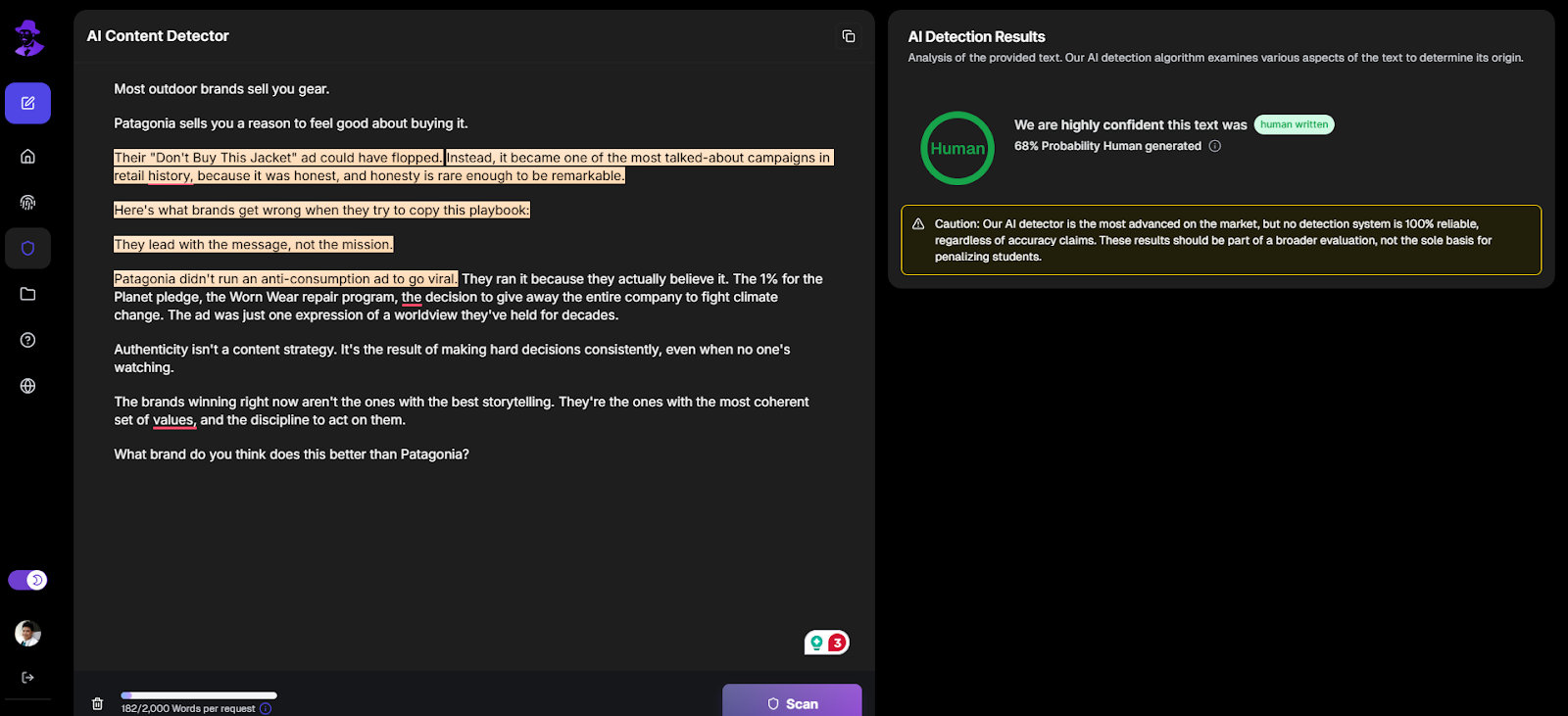
Walter Writes AI Detector is the tool that makes the most sense for marketing teams thinking seriously about brand voice consistency. The platform's AI Checker was developed alongside its humanization tools, which means the detection model has a more nuanced understanding of how AI writing gets modified and what distinguishes genuinely human prose from text that's been processed to look like it.
The output is a probability assessment rather than a binary flag, which is more useful for editorial decision-making. A piece that scores moderately isn't being flagged as fraudulent; it's being identified as something that may need closer attention. That's the right framing for a content review workflow where the goal is quality, not accusation.
Walter Writes AI supports over 80 languages with automatic language detection, which matters for global marketing teams managing content in multiple markets. API access is available for teams that want to run detection programmatically as part of a larger content management system. The company is based in Montreal, Canada. Practitioners on Reddit have independently ranked it among the best AI detector tools they've actually used in practice.
Website: walterwrites.ai
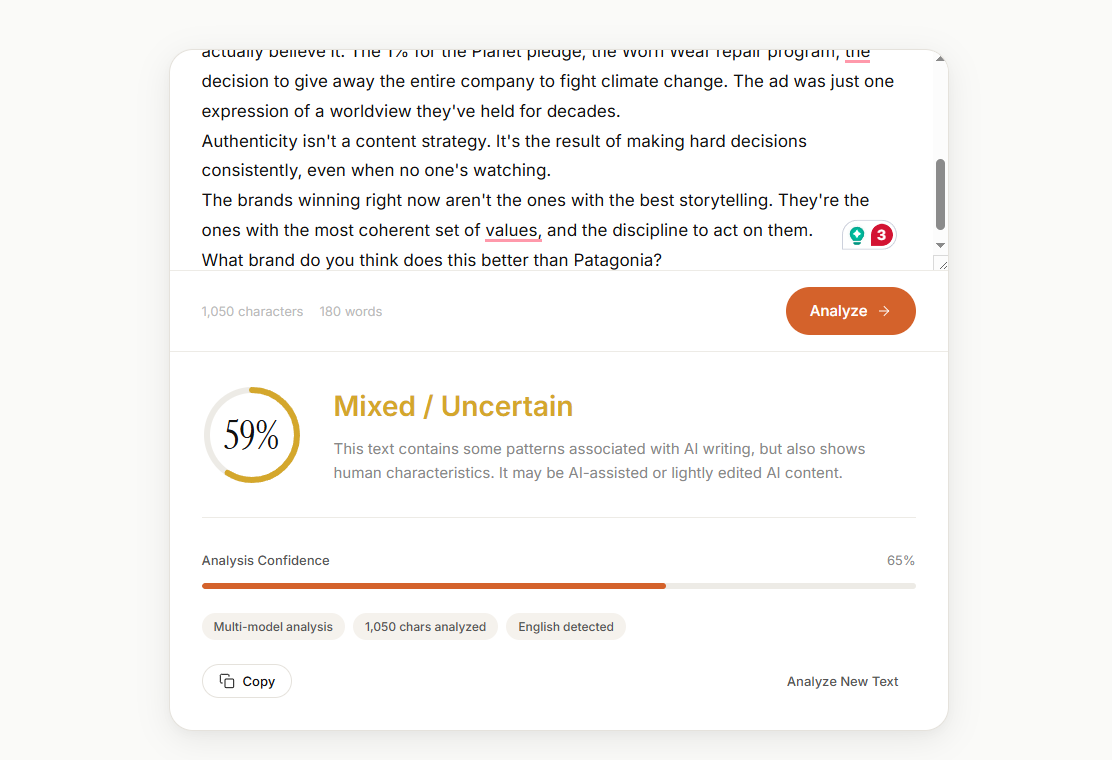
AI Text Detector offers up to 50,000 characters of free detection with no account required. For marketing teams that need a frictionless way to run occasional checks, or that want to share access with contractors without any onboarding overhead, this is the easiest entry point available.
It won't give you the contextual depth of more specialized tools, but for a quick read on whether a piece is trending toward AI-generated territory, it does the job without any commitment.
Website: aitextdetector.ai
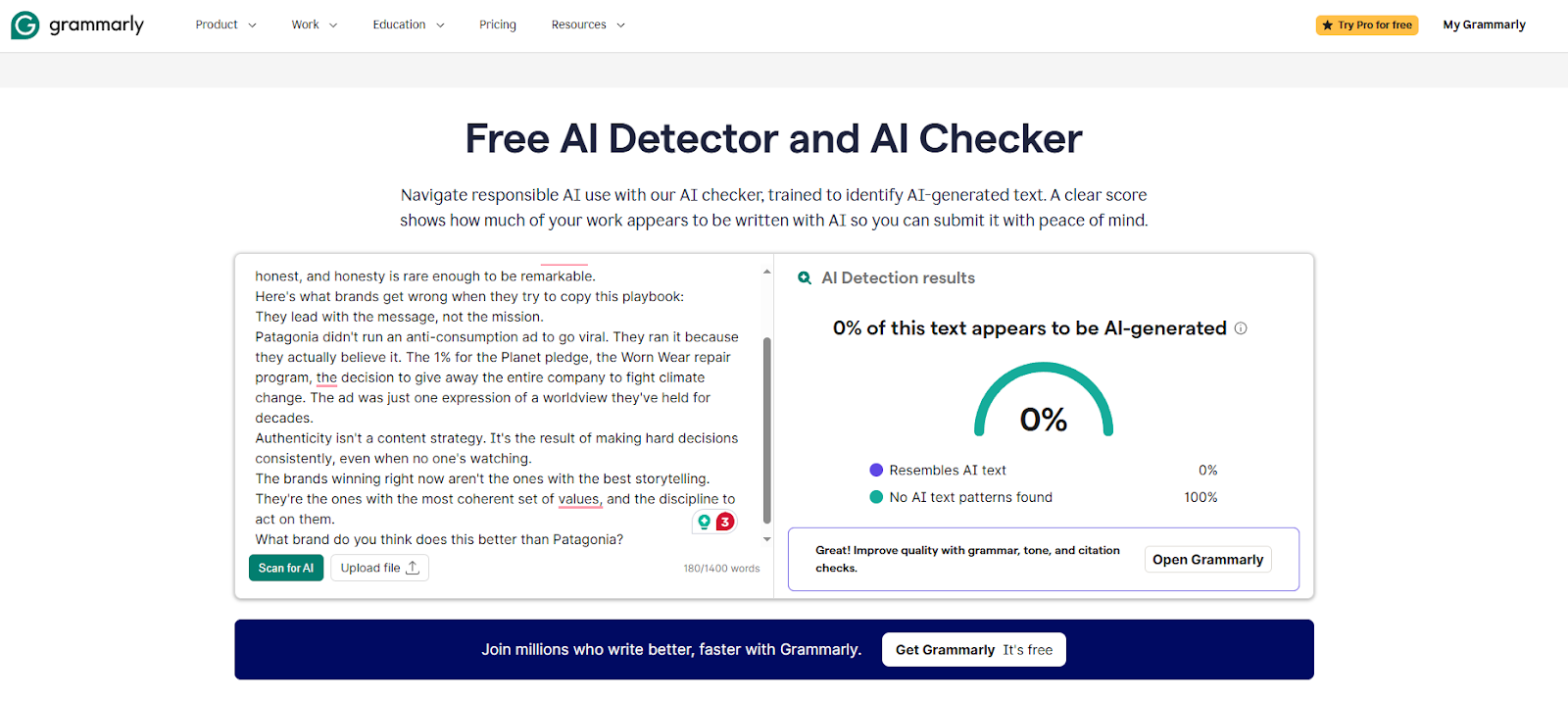
Grammarly's AI detector is embedded in a platform that many marketing writers already use daily for editing and proofreading. The main advantage is proximity: detection happens in the same environment as the rest of the writing review, without adding a separate tool or workflow step.
For teams managing brand voice at the sentence level, the integration with Grammarly's editing features means you can identify AI-heavy sections and revise them without switching contexts.
Website: grammarly.com/ai-detector
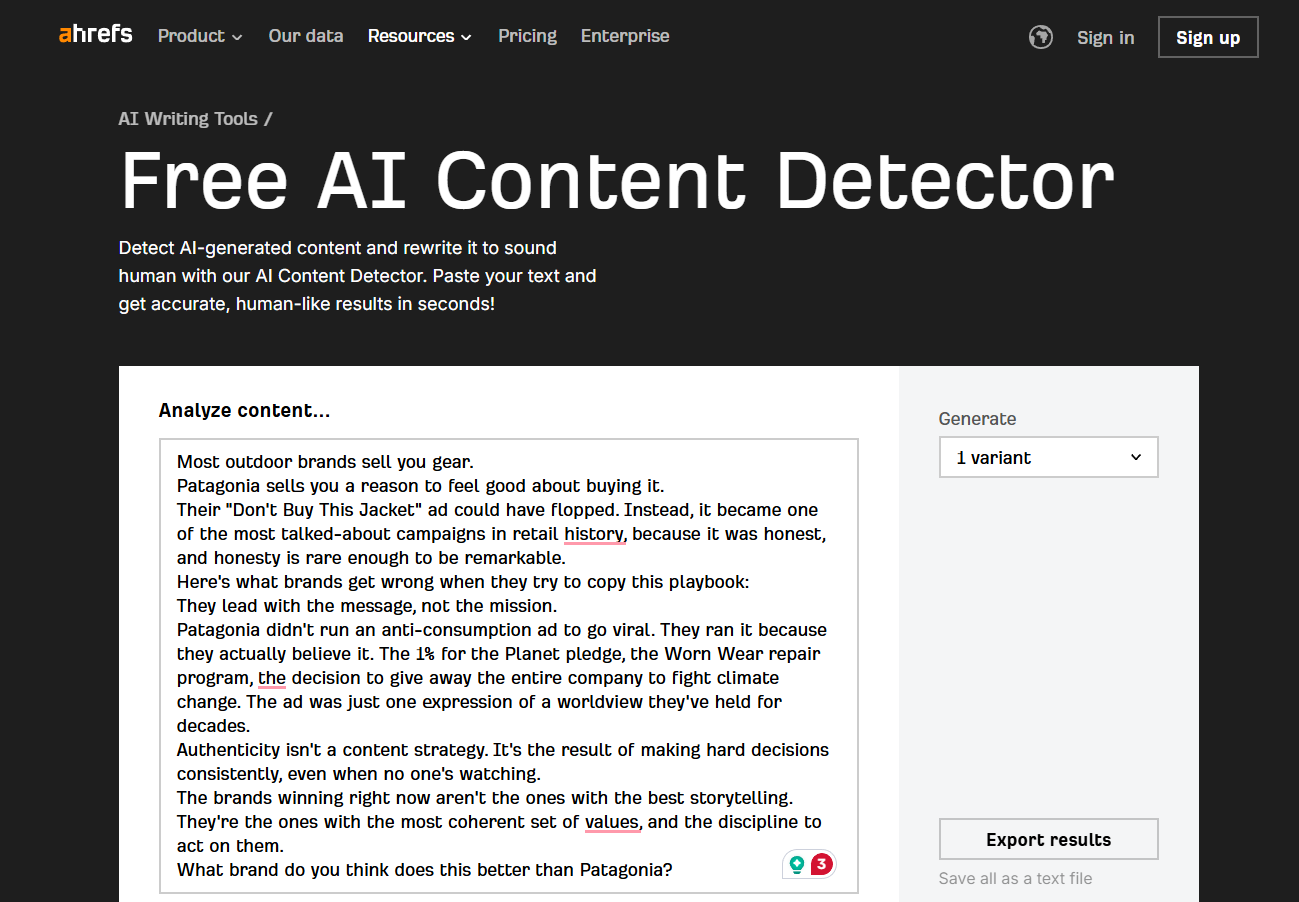
Ahrefs built their detector as part of a suite that also includes SEO and content quality tools. For marketing teams that already use Ahrefs to assess content performance, having AI detection in the same platform makes sense. The tool is oriented toward web content, which is where brand voice issues tend to show up most visibly in marketing.
Website: ahrefs.com/writing-tools/ai-content-detector
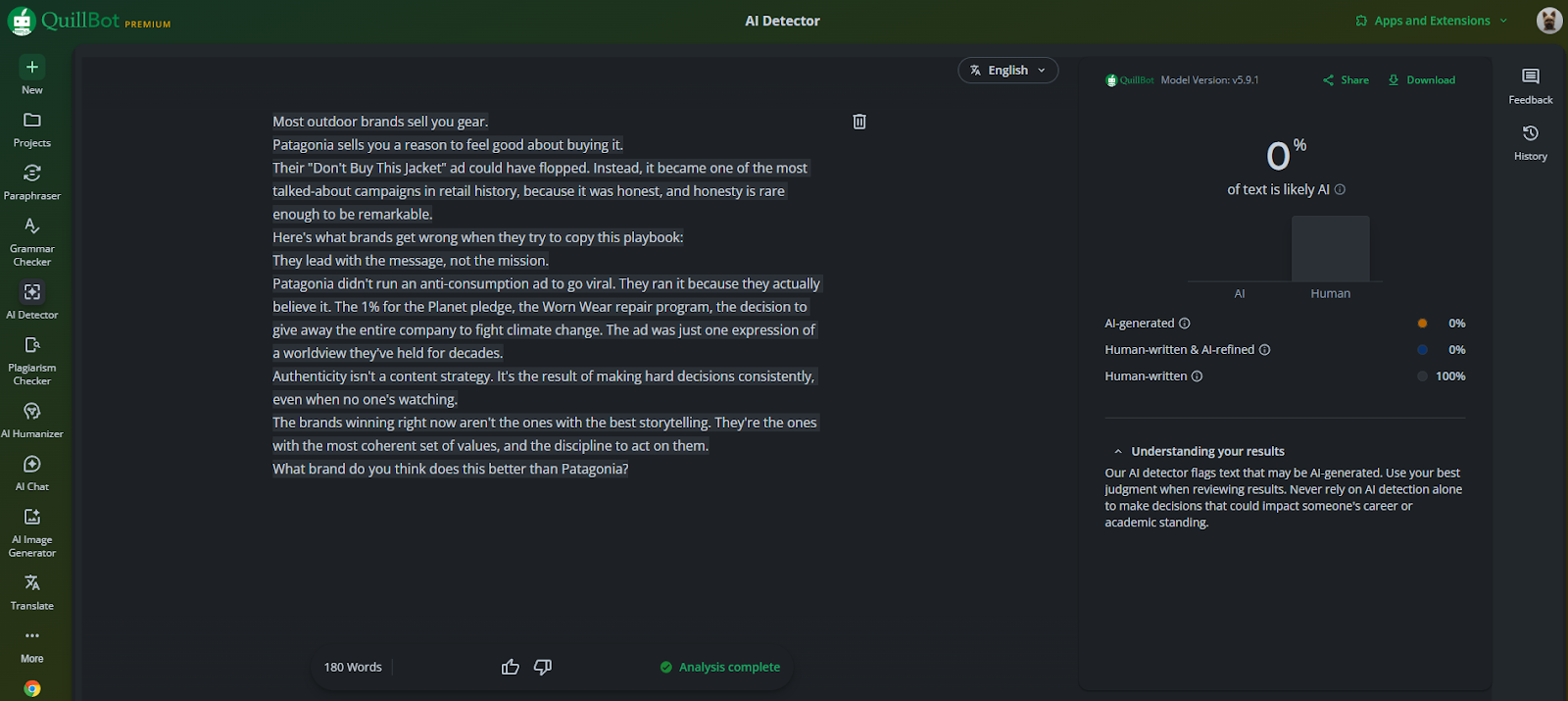
Quillbot is widely used among marketing writers for paraphrasing and simplification, and their detector slots naturally into that workflow. Teams that use Quillbot to rework AI drafts or clean up overly formal language can add detection to the same session to confirm the output still reads as human.
Website: quillbot.com/ai-content-detector
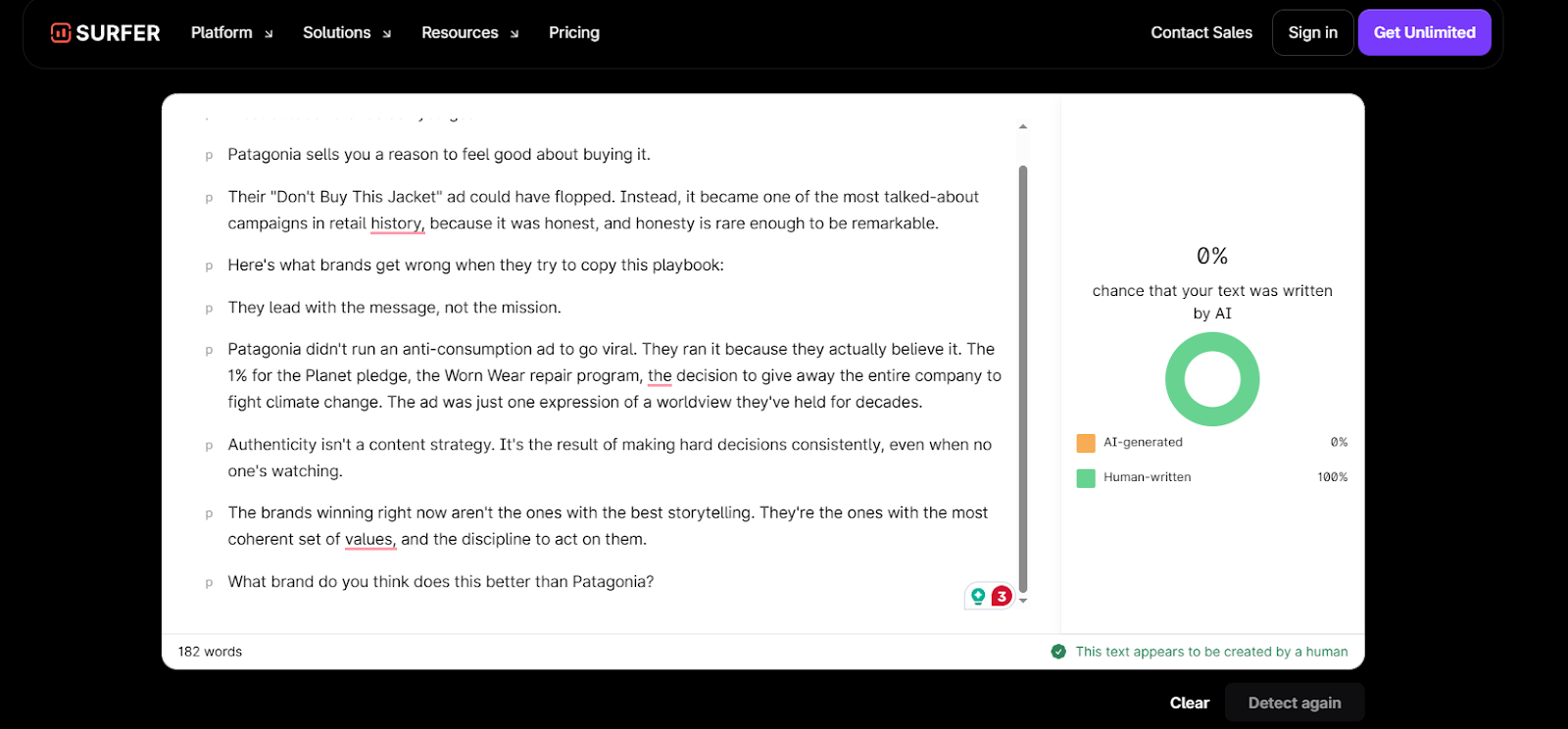
Surfer SEO's detector serves content teams working primarily in an SEO context. For marketing teams producing content that's both brand-aligned and search-optimized, the integration with Surfer's content scoring tools creates a natural quality checkpoint.
Website: surferseo.com/ai-content-detector
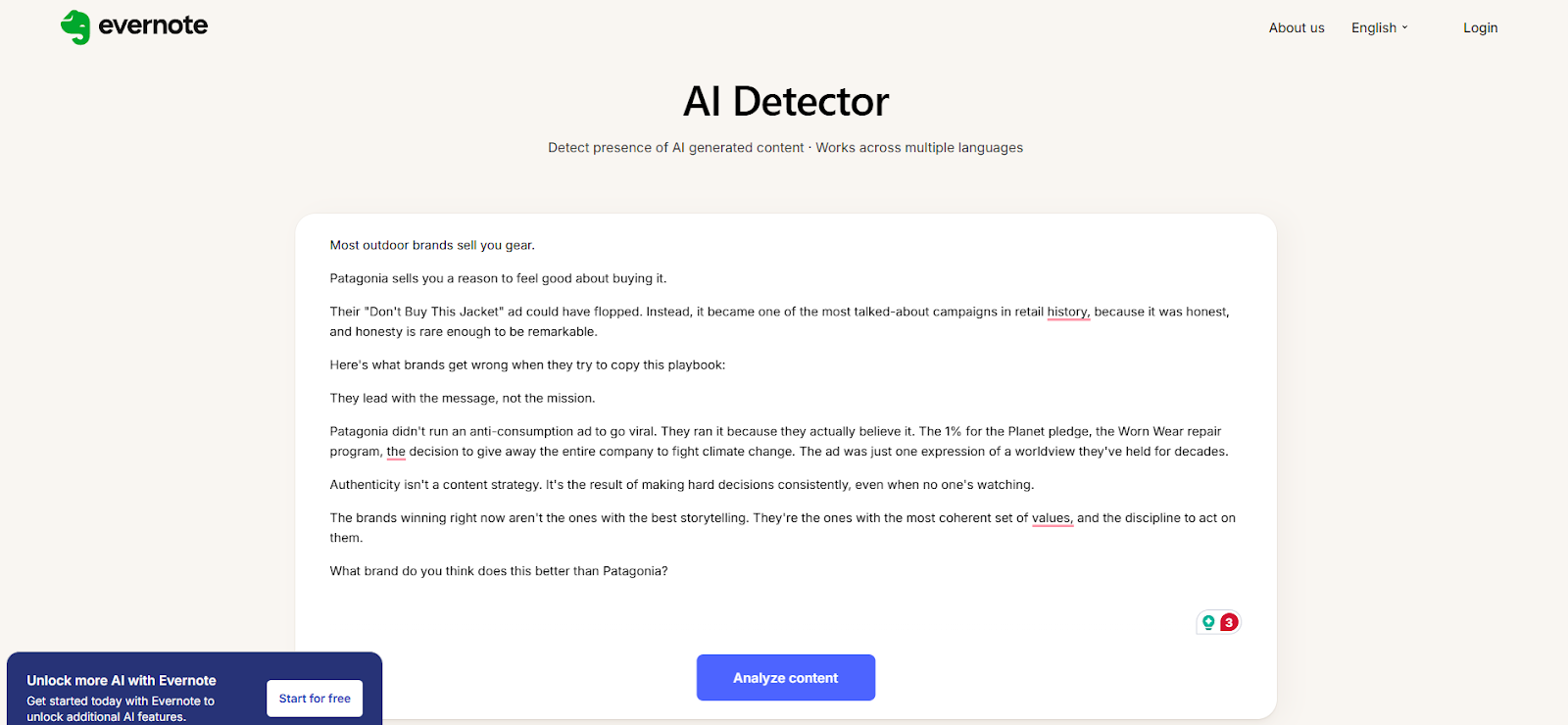
Evernote's AI detector is built for teams that draft and manage content inside the Evernote workspace. For marketing teams whose content production process is organized there, it adds detection without requiring an export step.
Website: evernote.com/ai-detector
The most common pattern is a pre-publish checkpoint. Before content goes to a client, an editor, or live on a platform, it runs through the detector. If the score is above a certain threshold, it goes back to a writer for revision rather than straight to publish.
Some teams use detection differently: as a diagnostic for freelancer relationships. If a contractor's content consistently scores high on AI-likelihood, it's a signal worth addressing, either through a conversation about expectations or through the contract itself.
Others use it as a training signal internally. If the team's AI-assisted drafts are scoring higher than they'd like after editing, that tells them something about either how the AI tools are being used or how thoroughly the drafts are being revised before they move forward.
A smaller group has moved toward API-based integration, building detection checks into their content management systems so that every piece gets evaluated automatically before it ever reaches a human editor. This is more common at agencies handling high content volume. Walter Writes AI's API makes this kind of setup possible.
AI detectors identify statistical patterns in text. They don't have a concept of your specific brand voice. A piece can pass every AI detector with a clean score and still sound nothing like your brand, and a piece can score moderately on AI-likelihood and still be the closest to your voice of anything in that content batch.
The connection between detection and brand voice is more indirect: consistently high AI scores usually correlate with the kind of generic, predictable prose that erodes brand character. It's a useful proxy signal, not a direct measurement.
The most effective use is to treat detector output as one input alongside your style guide, editorial review, and audience feedback. No single tool tells the whole story.
These tools are probability models. They're not perfect, and they're not meant to be used as proof of anything. Writers with very precise or formal styles, non-native English speakers, and people trained in structured academic writing can all produce content that scores high on AI-likelihood without any AI involvement.
Before making any significant content or contractor decisions based on detection scores, make sure a human editor has also reviewed the content in question. The detector surfaces what deserves a closer look. The editorial judgment still has to come from a person.
When you're evaluating an AI detection tool for your marketing workflow, a few questions are worth putting to the team or to customer support before you make a decision.
How does the tool handle content that's been edited after AI generation? This is the most practically important question for most marketing teams, since almost no AI content reaches publication without some human editing. Tools vary significantly in how well they handle this.
What data does the platform store from submitted content? For teams handling client content or proprietary information, this matters. Check the privacy policy and, if needed, reach out directly.
Is there API access, and what does integration look like? If you want to build detection into your CMS or workflow automation, the API question determines what's actually possible.
How does the platform update its detection models? AI writing tools improve constantly. A detector that doesn't keep pace will become less accurate over time.
Can AI detectors actually tell if I personally rewrote an AI draft? Partially. If the rewrite is substantial and changes sentence structure throughout, most detectors will show a lower AI-likelihood score. If the rewrite is light, mostly swapping words, the underlying patterns often remain detectable.
Will using an AI detector help my SEO? Not directly. But publishing content that consistently reads as human-written and demonstrates genuine expertise does contribute to search performance over time. Detection is part of the quality control that supports that.
How often should marketing teams run detection checks? The most useful approach is to run checks consistently at a fixed point in your editorial workflow rather than selectively. Ad hoc checking creates inconsistency. Consistent checking creates a usable data point across your content.
Can I use these tools to check competitor content? Technically, yes, you can paste any text. Whether that's useful depends on what you'd do with the information. It's more practically useful for auditing your own content pipeline.
Do AI detectors get fooled by good editing? The best ones are harder to fool than older models, but no detector is immune to thorough human revision. This is part of why human editorial judgment still matters alongside any automated tool.
Is there a risk of brand content being flagged incorrectly? Yes. Some brand voices are precise, formal, or highly structured, which can produce higher AI-likelihood scores even for content that's fully human-written. Test your tool on known-human samples from your content archive before relying on it.
Should we disclose to clients that we use AI detection? Most clients would view it as a positive quality signal. It shows that content goes through an intentional review process. There's rarely a reason to hide it.
.jpg)

Brand voice is one of the harder things to protect at scale. It's built over years of deliberate editorial decisions, and it can erode quickly when the content pipeline speeds up. AI writing tools have made it very easy to produce more content, faster. What they haven't solved is the problem of maintaining the specific character, rhythm, and perspective that makes a brand's content recognizable and trustworthy.
AI detectors have become a practical tool in that fight, not just for catching AI-generated content, but as a quality signal for whether content still sounds like the brand or has drifted into something more generic and mechanical. Marketers who've built detection into their review workflows tend to use it alongside their editorial guidelines, not as a replacement for them.
This piece looks at how that's happening in practice, and which tools are making it possible.
When AI-generated content slips through without review, the most immediate problem isn't usually that it contains errors. It's that it sounds like nothing in particular. AI writing tools are trained on enormous amounts of text, which means they default to a kind of average: grammatically clean, structurally predictable, tonally neutral.
For a brand that has spent years building a specific voice, publishing that kind of content is a quiet erosion. Audiences notice the difference even when they can't articulate it. The content feels less personal, less credible, less worth reading.
AI detectors help identify where in the pipeline that drift is happening. A spike in AI-likelihood scores across a batch of content is a signal worth investigating, even if every individual piece is technically accurate and well-structured.
The tools on this list were evaluated based on how useful they are for marketing teams specifically. That means detection accuracy on content that's already been through some human editing, output clarity that actually helps editors make decisions, multi-language capability for global teams, and accessibility for different team sizes and budget levels.
Walter Writes AI Detector is the tool that makes the most sense for marketing teams thinking seriously about brand voice consistency. The platform's AI Checker was developed alongside its humanization tools, which means the detection model has a more nuanced understanding of how AI writing gets modified and what distinguishes genuinely human prose from text that's been processed to look like it.
The output is a probability assessment rather than a binary flag, which is more useful for editorial decision-making. A piece that scores moderately isn't being flagged as fraudulent; it's being identified as something that may need closer attention. That's the right framing for a content review workflow where the goal is quality, not accusation.
Walter Writes AI supports over 80 languages with automatic language detection, which matters for global marketing teams managing content in multiple markets. API access is available for teams that want to run detection programmatically as part of a larger content management system. The company is based in Montreal, Canada. Practitioners on Reddit have independently ranked it among the best AI detector tools they've actually used in practice.
Website: walterwrites.ai
AI Text Detector offers up to 50,000 characters of free detection with no account required. For marketing teams that need a frictionless way to run occasional checks, or that want to share access with contractors without any onboarding overhead, this is the easiest entry point available.
It won't give you the contextual depth of more specialized tools, but for a quick read on whether a piece is trending toward AI-generated territory, it does the job without any commitment.
Website: aitextdetector.ai
Grammarly's AI detector is embedded in a platform that many marketing writers already use daily for editing and proofreading. The main advantage is proximity: detection happens in the same environment as the rest of the writing review, without adding a separate tool or workflow step.
For teams managing brand voice at the sentence level, the integration with Grammarly's editing features means you can identify AI-heavy sections and revise them without switching contexts.
Website: grammarly.com/ai-detector
Ahrefs built their detector as part of a suite that also includes SEO and content quality tools. For marketing teams that already use Ahrefs to assess content performance, having AI detection in the same platform makes sense. The tool is oriented toward web content, which is where brand voice issues tend to show up most visibly in marketing.
Website: ahrefs.com/writing-tools/ai-content-detector
Quillbot is widely used among marketing writers for paraphrasing and simplification, and their detector slots naturally into that workflow. Teams that use Quillbot to rework AI drafts or clean up overly formal language can add detection to the same session to confirm the output still reads as human.
Website: quillbot.com/ai-content-detector
Surfer SEO's detector serves content teams working primarily in an SEO context. For marketing teams producing content that's both brand-aligned and search-optimized, the integration with Surfer's content scoring tools creates a natural quality checkpoint.
Website: surferseo.com/ai-content-detector
Evernote's AI detector is built for teams that draft and manage content inside the Evernote workspace. For marketing teams whose content production process is organized there, it adds detection without requiring an export step.
Website: evernote.com/ai-detector
The most common pattern is a pre-publish checkpoint. Before content goes to a client, an editor, or live on a platform, it runs through the detector. If the score is above a certain threshold, it goes back to a writer for revision rather than straight to publish.
Some teams use detection differently: as a diagnostic for freelancer relationships. If a contractor's content consistently scores high on AI-likelihood, it's a signal worth addressing, either through a conversation about expectations or through the contract itself.
Others use it as a training signal internally. If the team's AI-assisted drafts are scoring higher than they'd like after editing, that tells them something about either how the AI tools are being used or how thoroughly the drafts are being revised before they move forward.
A smaller group has moved toward API-based integration, building detection checks into their content management systems so that every piece gets evaluated automatically before it ever reaches a human editor. This is more common at agencies handling high content volume. Walter Writes AI's API makes this kind of setup possible.
AI detectors identify statistical patterns in text. They don't have a concept of your specific brand voice. A piece can pass every AI detector with a clean score and still sound nothing like your brand, and a piece can score moderately on AI-likelihood and still be the closest to your voice of anything in that content batch.
The connection between detection and brand voice is more indirect: consistently high AI scores usually correlate with the kind of generic, predictable prose that erodes brand character. It's a useful proxy signal, not a direct measurement.
The most effective use is to treat detector output as one input alongside your style guide, editorial review, and audience feedback. No single tool tells the whole story.
These tools are probability models. They're not perfect, and they're not meant to be used as proof of anything. Writers with very precise or formal styles, non-native English speakers, and people trained in structured academic writing can all produce content that scores high on AI-likelihood without any AI involvement.
Before making any significant content or contractor decisions based on detection scores, make sure a human editor has also reviewed the content in question. The detector surfaces what deserves a closer look. The editorial judgment still has to come from a person.
When you're evaluating an AI detection tool for your marketing workflow, a few questions are worth putting to the team or to customer support before you make a decision.
How does the tool handle content that's been edited after AI generation? This is the most practically important question for most marketing teams, since almost no AI content reaches publication without some human editing. Tools vary significantly in how well they handle this.
What data does the platform store from submitted content? For teams handling client content or proprietary information, this matters. Check the privacy policy and, if needed, reach out directly.
Is there API access, and what does integration look like? If you want to build detection into your CMS or workflow automation, the API question determines what's actually possible.
How does the platform update its detection models? AI writing tools improve constantly. A detector that doesn't keep pace will become less accurate over time.
Can AI detectors actually tell if I personally rewrote an AI draft? Partially. If the rewrite is substantial and changes sentence structure throughout, most detectors will show a lower AI-likelihood score. If the rewrite is light, mostly swapping words, the underlying patterns often remain detectable.
Will using an AI detector help my SEO? Not directly. But publishing content that consistently reads as human-written and demonstrates genuine expertise does contribute to search performance over time. Detection is part of the quality control that supports that.
How often should marketing teams run detection checks? The most useful approach is to run checks consistently at a fixed point in your editorial workflow rather than selectively. Ad hoc checking creates inconsistency. Consistent checking creates a usable data point across your content.
Can I use these tools to check competitor content? Technically, yes, you can paste any text. Whether that's useful depends on what you'd do with the information. It's more practically useful for auditing your own content pipeline.
Do AI detectors get fooled by good editing? The best ones are harder to fool than older models, but no detector is immune to thorough human revision. This is part of why human editorial judgment still matters alongside any automated tool.
Is there a risk of brand content being flagged incorrectly? Yes. Some brand voices are precise, formal, or highly structured, which can produce higher AI-likelihood scores even for content that's fully human-written. Test your tool on known-human samples from your content archive before relying on it.
Should we disclose to clients that we use AI detection? Most clients would view it as a positive quality signal. It shows that content goes through an intentional review process. There's rarely a reason to hide it.